
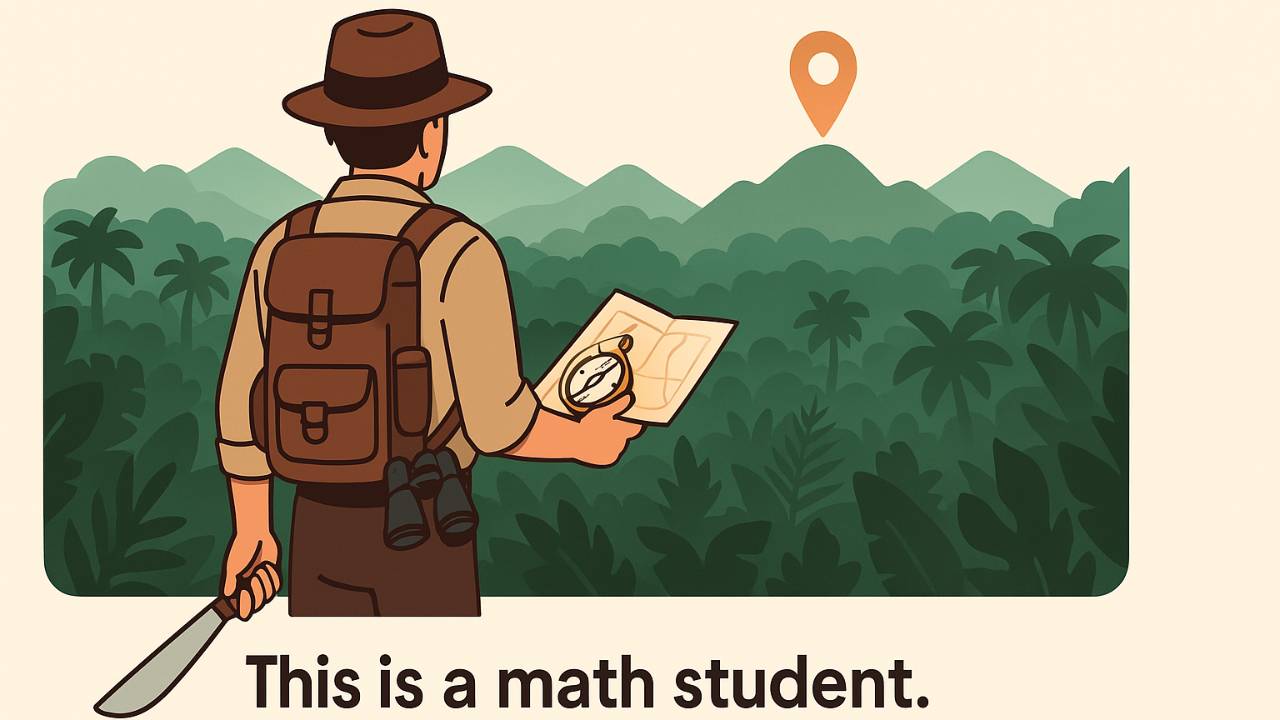
Exercises Are Expeditions – How Problems Help Map the Bigger Picture
Remember the last time you got lost in a Math or Physics problem, unsure where to go next?
That’s what it feels like to explore a new land without knowing the paths.
When students begin a new topic, especially in exam-heavy subjects like Mathematics or Physics, the terrain can feel overwhelming. Concepts blur together, methods feel disconnected, and each new chapter adds another layer of confusion. It’s like being dropped into the middle of a dense jungle or a foreign land where everything is unfamiliar and the way forward is unclear.
But no explorer sets out without a goal.
The Map and the Mission – The Role of the Grab Phase
Just as every expedition starts with a mission, every student starts with the objective of solving a problem or mastering a topic. But a goal isn’t enough—you need a sense of direction. That’s what the Grab phase provides: a map.
The Grab phase is the first step in the GHOST BUST Framework. It introduces a concept with clarity and purpose—just enough to set the student in motion without overwhelming them with abstraction. It’s the stage where the student learns what they are dealing with, why it matters, and what the general shape of it is. It’s the moment the explorer opens the map and gets oriented.
Equipped to Move – Tools from the Hold Phase
No explorer ventures out unprepared. They carry tools: a machete to cut through the brush, binoculars to scan the path ahead, and a compass to stay on course. Students are no different. Their tools are the core principles, equations, and conceptual insights they’ve gathered and practiced during the Hold phase.
In a previous post, I explored how exercises in the Hold phase act like torches—each one shedding light on different parts of a concept. This foundational work equips students with the problem-solving instincts and tools they need to begin exploring more complex terrain.
Finding the First Track – The Power of Multi-Step Problems
Explorers rarely walk in a straight line. Instead, they search for signs—a broken branch, a clearing, a distant sound—that lead them to the next checkpoint. In the same way, students use each step of a problem to move closer to a solution.
A well-designed multi-step problem is more than a task—it’s a journey. It begins with a known starting point and asks the student to make use of their tools, their map, and their reasoning to discover each new step. Every required step of the question is a checkpoint, and each solved checkpoint boosts confidence and refines understanding.
Clearing the Path
As the explorer repeats the route, the trail becomes clearer. The same happens in problem-solving. With repetition, strategies become familiar. What once looked like a tangled mess of variables and conditions now follows a structure. The once-intimidating jungle becomes navigable.
Students start recognizing familiar patterns. They anticipate the types of tools required. They become quicker and more precise—not because they’ve memorized solutions, but because they’ve carved out the path with their own effort.
The Bigger Picture – Seeing the Forest
Eventually, the explorer finds high ground. From there, they can look back and understand the landscape as a whole—how rivers connect, how trails cross, where the densest parts of the forest are, and where the clearest paths lie.
This is the final stage of problem-based learning: when students begin to see how different concepts interlink. They recognize that what they’ve learned in algebra applies to physics. That a technique in calculus unlocks a mechanics problem. That mathematical structures echo across topics. This is conceptual fluency—not isolated mastery, but integrated understanding.
** The Journey Is the Learning**
Exercises are not just drills. They are expeditions—each one an opportunity to explore, discover, and connect. While the Grab phase hands students a map and the Hold phase equips them with tools, it’s the solving of problems that carves out real pathways through the subject.
And once those paths are walked often enough, they don’t just lead to solutions—they lead to understanding.
The GHOST BUST Framework was designed to guide students through this exact process. From orientation to insight. From confusion to clarity. From forest floor to panoramic view.
What Former Students Say About Me

@2024 Mr. Miranda Online | All Rights Reseved