
The Limits of Tutoring and the Power of Structure
In my last post, I explored the unique challenges faced by homeschooled students as they prepare for final Maths exams. The missing structure, the scattered resources, and the loneliness of working without peers make the journey exhausting. But even for students who are not homeschooled, the most common solution - traditional tutoring - does not always provide the complete answer.
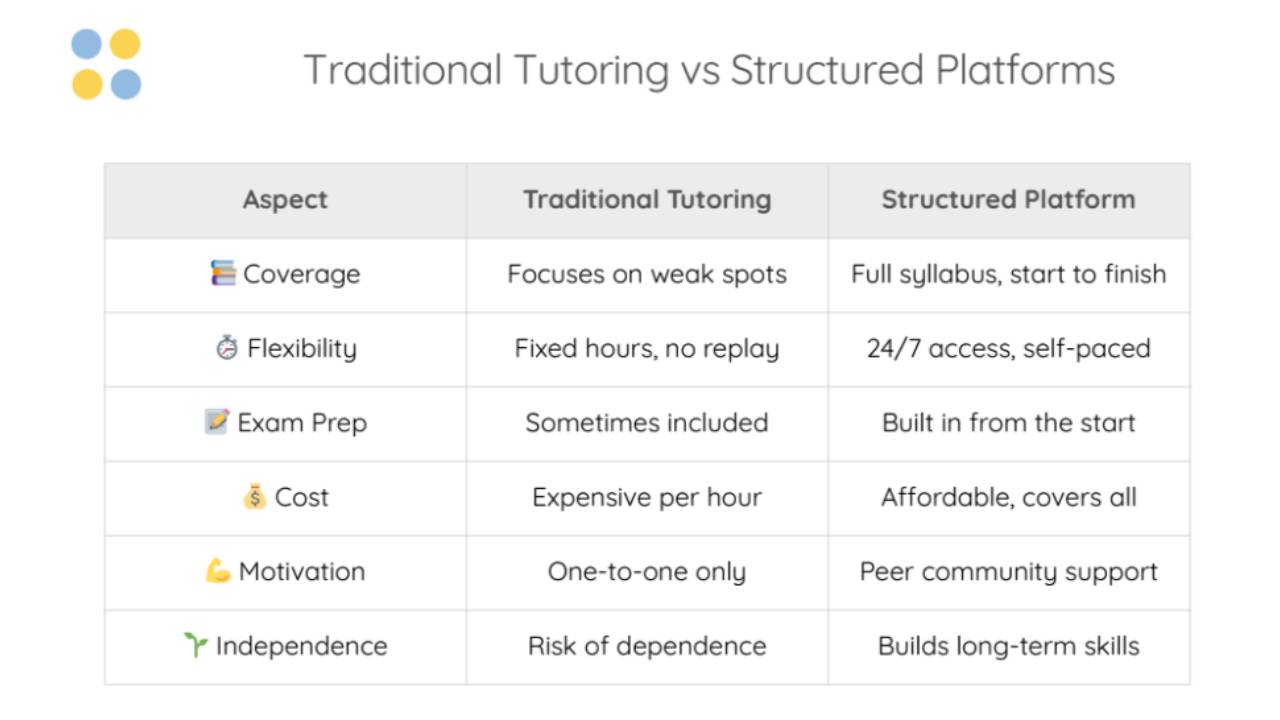
Tutoring is valuable. A good tutor can explain a difficult concept clearly, help rebuild confidence, and offer guidance in areas where a student feels lost. Yet tutoring often works in short bursts, reacting to immediate needs rather than building the kind of structured, exam-focused preparation that final-year students require. One hour a week might clear up confusion in algebra, but it rarely ensures that the entire syllabus is mastered or that exam technique is thoroughly developed.
This is where structured digital approaches have begun to show their strength. They offer a complete syllabus journey, from first principles to final revision, ensuring that no chapter is skipped and no idea is left to chance. Instead of chasing gaps as they appear, students move through a coherent plan that balances content, practice, and exam technique. Lessons are always available, explanations can be revisited, and progress does not depend on the calendar.
The contrast becomes sharper when exam technique enters the picture. Tutors sometimes address it, but often it is left for the final weeks, when time is running short. A structured platform weaves exam-style practice into the learning itself, so that every topic is not only understood but also applied in the way examiners expect. Students arrive at the exam room having already rehearsed the very skills they will need under timed conditions.
There is also the question of cost and sustainability. Hourly tutoring is expensive, and covering a full syllabus usually requires far more than a handful of lessons. A structured platform provides continuous access for the price of just a few hours of tutoring, with the added advantage of breadth: worked solutions, assessments, strategies, and a community of peers. That community is more than an add-on; for many students it is the difference between feeling alone and being part of a shared journey.
Tutoring can be personal, but it is rarely scalable. A tutor’s time is limited, and progress depends on fitting into their schedule. Structured approaches, by contrast, allow students to learn on their own terms, at their own pace, and in their own time zone. The lessons can be paused, replayed, and revisited until clarity is achieved. Independence is built into the process, and with it comes a sense of ownership that tutoring often struggles to create.
For students preparing for final Maths exams, both tutoring and structured platforms can play a role. But more and more, it is clear that structured approaches offer something tutoring cannot: the combination of complete coverage, exam focus, community, and flexibility, all delivered in a way that makes long-term success more achievable.
Over the past three years, I have been building such a solution; one that brings together the best of structure and support into a single platform. It will be launched in mid-October, and in the next post I will share more about what it contains and how it can transform the experience of preparing for Maths and Physics exams.
What Former Students Say About Me

@2024 Mr. Miranda Online | All Rights Reseved